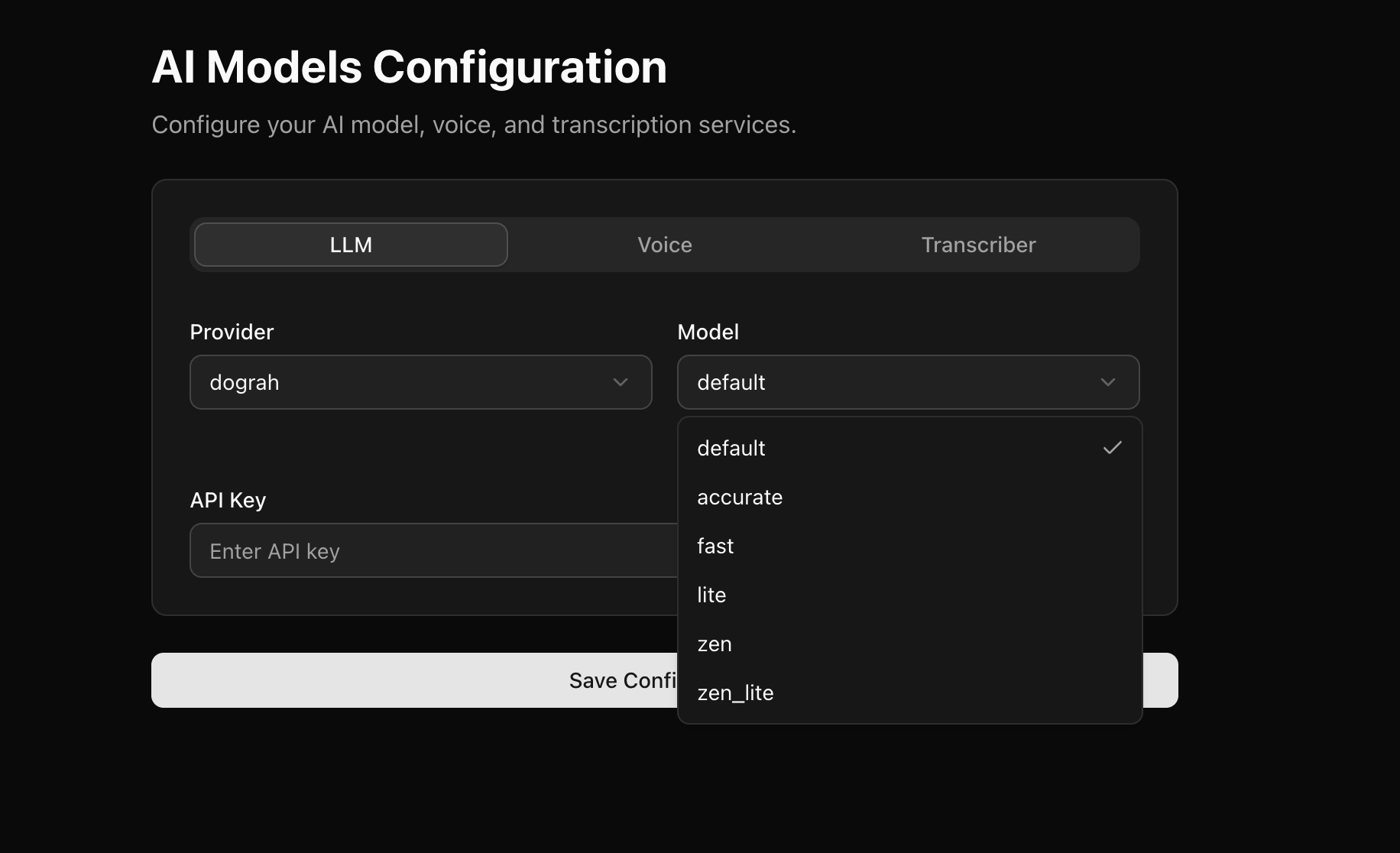
Voice Agents use LLM (Large Language Models), which are trained to understand the conversational context, and respond to users.
Dograh platform supports OpenAI, Google AI Studio, Google Vertex AI, Azure OpenAI, AWS Bedrock, Groq, Hopper, OpenRouter, Hugging Face, MiniMax, Sarvam, and Dograh-managed LLMs. There are some models provided by default for you to choose from the drop down.
LLM providers receive the data needed to generate responses, such as prompts, conversation history, model settings, and any configured tool/function definitions or tool call context. Review the provider’s data processing, retention, model training, and regional hosting policies before using sensitive data.
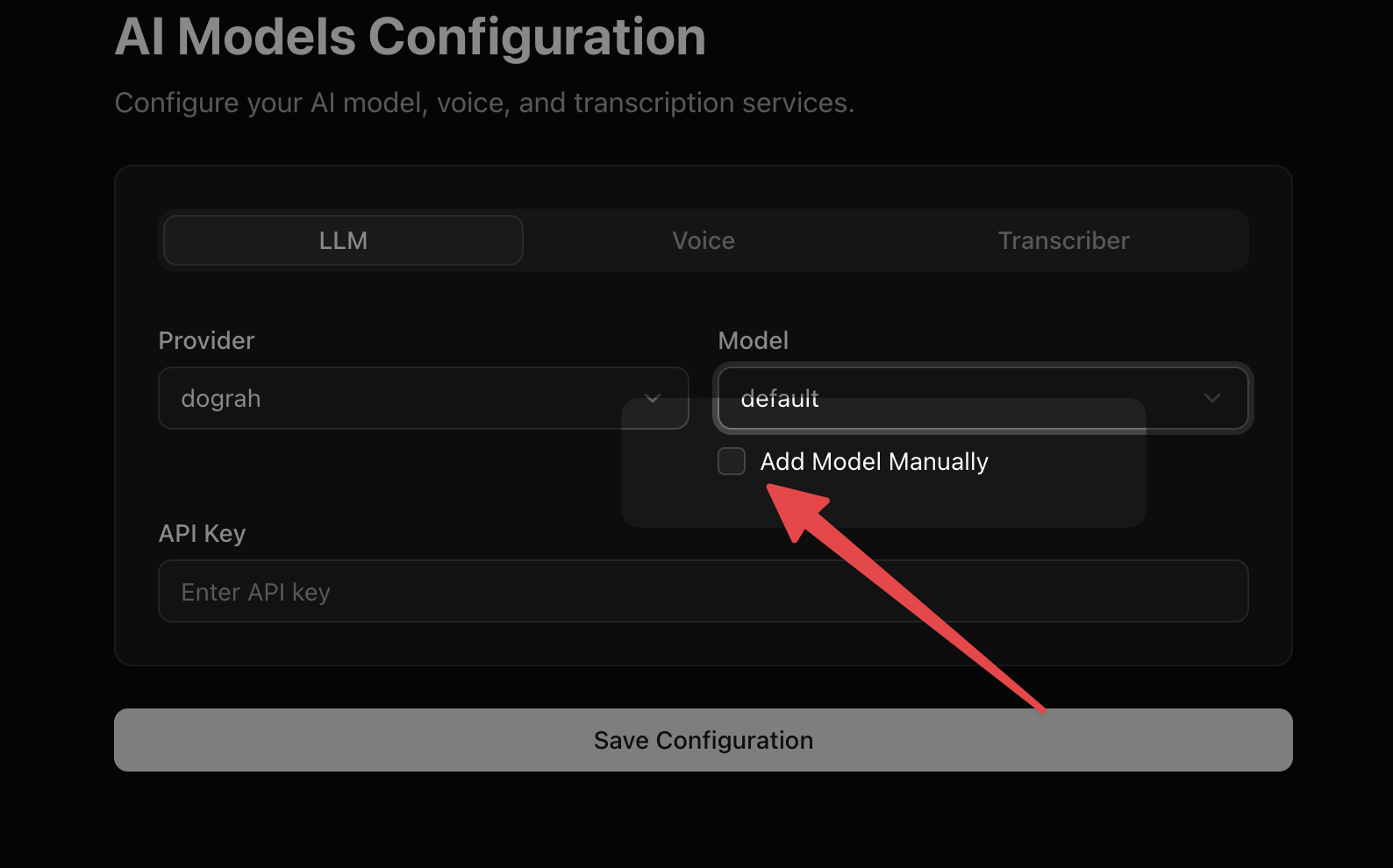
For locally deployed or self-hosted LLMs, Dograh also supports OpenAI-compatible endpoints such as Ollama and vLLM.If you don’t find a model in the drop down, you can always add a model manually.
By default OpenRouter spreads requests across every provider that serves a model, weighted toward the cheapest. For voice agents that can add noticeable latency, because each turn may land on a slower provider.Use Provider order to list the OpenRouter provider slugs to try first, in order, one slug per entry (for example, groq). The slugs are shown on each model’s page on OpenRouter. If none of the listed providers is available, OpenRouter falls back to its other providers, so calls keep working.
Assistant
Responses are generated using AI and may contain mistakes.